
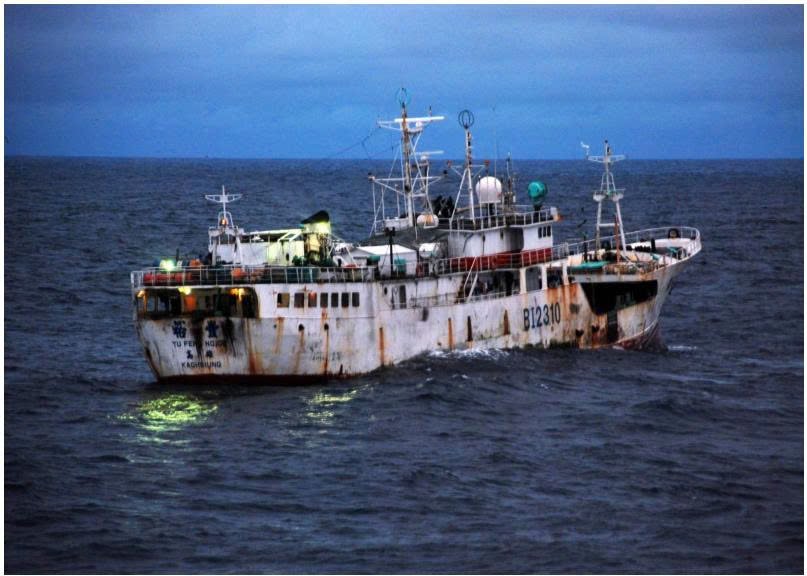
According to new research from the University of British Columbia (UBC), industrial-scale illegal fishing continues to undermine ocean sustainability, coastal community livelihoods, and the global seafood market, despite decades of improved management and recent advances in monitoring technology.
The study, titled “Casting light on the workings of illegal fishing markets,” was published in the journal Proceedings of the National Academy of Sciences (PNAS).
This comprehensive analysis examines how illegal mining operates, the areas where most of the illegal activity is concentrated, and the reasons why this situation persists.
A global issue, but with uneven impacts.
Studies indicate that industrial-scale illegal and unreported fishing accounts for approximately 8-15% of the total global natural marine fisheries catch, generating an illegal seafood trade worth around $6.2-$12.2 billion annually.
Although illegal fishing occurs worldwide, the level of impact varies greatly between regions. Approximately two-thirds of the value of the illegal trade originates from West Africa, East Asia, and Southeast Asia – regions that often have limited law enforcement capacity, while fisheries play a vital role in food security and employment.
Meanwhile, the majority of illegally harvested seafood is consumed in wealthier markets in North America, Europe, and East Asia, highlighting a stark inequality in the global seafood value chain.
Eliminating harmful subsidies is key to comprehensive reform.
Key priorities include eliminating harmful fisheries subsidies, mandating the use of electronic identification systems on fishing vessels, strengthening port state measures, enhancing transparency regarding true beneficiary owners, and improving international cooperation.
In addition, policies protecting small-scale and indigenous community fisheries, promoting co-management, and adjusting economic dynamics to encourage legal and sustainable fishing also play an important role.
While curbing illegal exploitation remains a major challenge, research suggests some positive signs have emerged, despite current geopolitical shocks to the global governance system.
For example, in 2025, the WTO ratified an agreement known as Fish 1 aimed at eliminating certain forms of harmful subsidies, while also pursuing a follow-up agreement called Fish 2 to strengthen these regulations. According to research, Fish 2 is currently facing opposition from India, Indonesia, and the United States.
Furthermore, the Treaty on the High Seas has been in effect since January 17, 2026. Another sign that the international community may cooperate to combat illegal exploitation is that “China has finally become a member of the Port State Measures Agreement (PSMA)”.
How do illegally harvested seafood penetrate legal markets?
Illegal fishing is sustained through increasingly sophisticated product “laundering” mechanisms. Transshipment at sea, falsified documentation, mislabeling of species, and mixing illegally harvested products with legal products allow illegal seafood to pass through ports, processing plants, and retail systems undetected.
Weak port controls, inconsistent enforcement of international agreements, and a lack of transparency regarding ship ownership continue to facilitate these activities.
Large-scale offshore fishing fleets – often supported by fuel subsidies and other capacity-enhancing grants – have been identified as one of the main drivers of illegal fishing.
These fleets often operate under a “convenience flag,” re-registering vessels to evade sanctions and using complex business networks to conceal the true beneficial owners, thereby avoiding penalties.
Technology is helpful, but it’s not enough.
Satellite tracking, artificial intelligence (AI), and electronic monitoring systems have significantly improved the ability to detect suspicious mining activities.
However, the authors warn that technology alone cannot solve the problem. Enforcement remains fragmented, penalties are often insufficient to deter offenders, and political will is uneven, especially when large corporate interests or geopolitical factors are involved.
The damage is not limited to the environment.
The impact of illegal fishing extends far beyond simply depleting fish stocks.
According to Mr. Le Billon, this practice causes “significant economic losses for governments and coastal communities, increases food and nutritional insecurity, and leads to widespread labor exploitation on fishing vessels.”
In some contexts, illegal exploitation is also linked to corruption, smuggling, and maritime insecurity, further exacerbating social and political impacts.
Mr. Le Billon concluded that the complexity and lack of transparency in the seafood supply chain have facilitated the “laundering” of illegally harvested products and their entry into the global market through fraudulent documentation, transshipment operations, and weak port control systems.

Add Comment